Yesterday, a tragedy occurred in East Palo Alto, California. A small plane crashed in a residential neighborhood, tragically taking the lives of the three Tesla Motors employees on board but fortunately sparing children both in a daycare center located within feet of the crash site and those playing nearby.
As concerned neighbors and citizens of Silicon Valley, all of us at ShotSpotter wish to express our profoundest condolences to the families of the victims, the employees of Tesla Motors, the families whose homes and workplaces were damaged, and all those who were affected on the ground. When such tragedy occurs, it’s natural to want to help out in some way. As community members, we felt there was something we might be able to do to help with the crash investigation. Our normal policy would have been to keep the fact of our involvement confidential and not publically disclosed our assistance, as we have done in other cases (of different natures) over our fifteen year history. But since the East Palo Alto Police Department (our customer) and the National Transportation Safety Board (NTSB) have made our contribution public, we wanted to confirm their statements and clarify our minor role in helping to piece together the puzzle:
When we heard that a plane had crashed in an East Palo Alto neighborhood, all of us at ShotSpotter knew there was a high probability the city’s ShotSpotter Gunshot Location System had detected the incident.
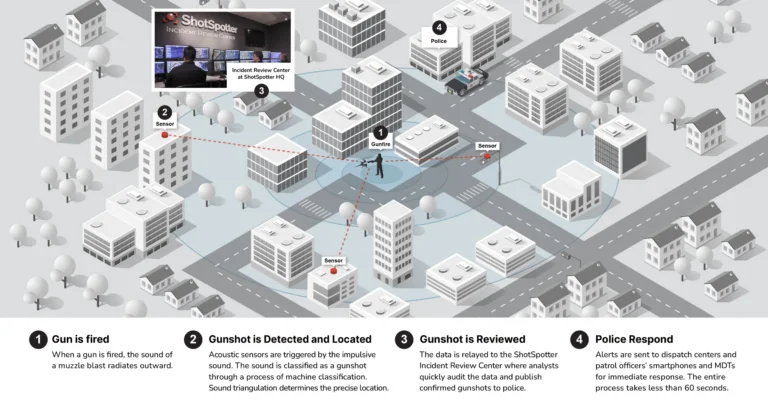
ShotSpotter systems are designed to trigger only on loud, impulsive noises (loosely speaking, things that go “bang”). Sadly, yesterday’s plane crash created such a noise and it did trigger more than one ShotSpotter sensor deployed in East Palo Alto. Through subsequent filtering, the ShotSpotter system automatically classified the event as loud and impulsive but not gunfire and therefore correctly did not report the incident in real time to the East Palo Alto Police dispatch. However, for forensic purposes, all loud, impulsive noises are logged by ShotSpotter systems, even if they do not trigger an automatic alert, in case those noises needed to be reviewed after-the-fact. (Note: this only applies to loud, impulsive noises, of which there are relatively few per day in any given city.)
Once we determined that the system had registered a loud, impulsive, non-gunfire noise at the time of the crash, we assisted the East Palo Alto Police Department with the retrieval and storage of the audio captured by their system’s ShotSpotter sensors for the seconds surrounding the impulsive noise (the crash). The East Palo Alto Police Department then provided that data to representatives of the National Transportation Safety Board to support their investigation of the crash. As with all audio associated with a ShotSpotter incident, the audio we assisted the East Palo Alto Police Department in providing to the NTSB starts a few seconds before the sound of the crash (providing the sound of the engines), includes the sound of the crash itself, and a few seconds after the crash. Because the ShotSpotter sensors each contain a GPS receiver with a precision clock, the NTSB now has a precise, millisecond-by-millisecond recording of the incident, as captured by several ShotSpotter sensors deployed throughout East Palo Alto. In total, five ShotSpotter sensors generated data which contribute consistently to the mathematical location of the crash. The sensors were located at various distances from the crash, the closest being just over 600 feet away and the furthest being roughly 1,500 feet away.
It is our hope that the audio recordings will help investigators establish the cause of the crash and thus perhaps make recommendations to avert future accidents. We spend our days at ShotSpotter developing a system which has saved numerous lives nationwide, and in this case we hope our data can help investigators establish what went wrong and thus, perhaps, avoid this tragedy repeating in the future.